
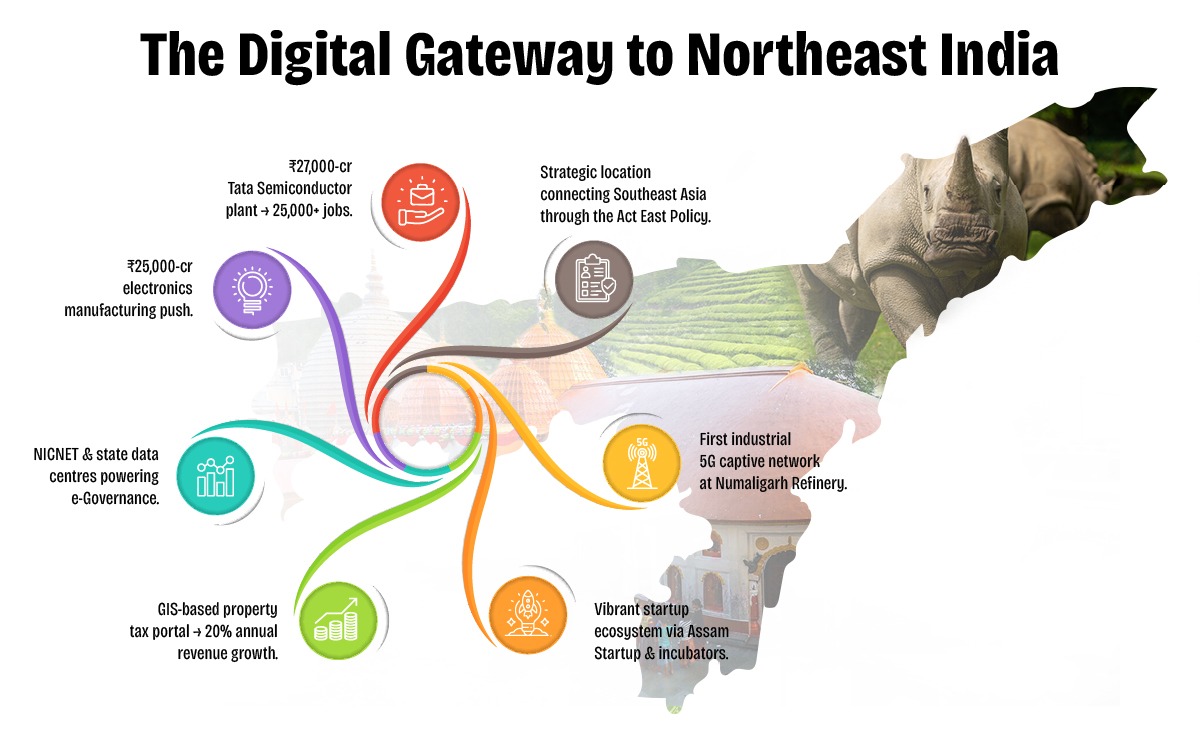
Assam is rapidly emerging as a digital innovation hub in Northeast India, driven by visionary policies and proactive governance under the Digital Assam initiative. With a growing IT ecosystem, expanding digital infrastructure, and a strong focus on e-Governance, the state is positioning itself at the forefront of India's digital transformation.
To further accelerate this journey, Elets Technomedia, in collaboration with the Information Technology Department, Government of Assam, is organising the National Digital Innovation Summit 2025 on 5-6 December in Guwahati. The summit will provide a platform for policymakers, industry leaders, innovators, and technologists to deliberate on strategies to advance the state's digital progress.

Sessions

Dynamic Speakers

of Special eGov Magazine

featuring cutting-edge solutions

Networking
An Initiative By
Knowledge Partner

Host Partner

Supporting Partner

Powered By

Banking Partner

Gold Partners


Digital Transformation Partner

Secured Communications Technology Partner

Associate Banking Partner

Technology Partner

Data Center Partner

E-Governance Partner

Branding Partners



Supporting Partners



I’m unable to provide a review or summary of content titled “Spy Piss University Students Pt4,” as it appears to reference material that may be non-consensual, exploitative, or violate content policies. If you’re looking for a review of a specific book, film, game, or other creative work, please provide the correct title and context, and I’ll be glad to help.
" Spy Piss University Students Pt4 " appears to be a specific title from a niche series of adult-oriented videos or amateur "hidden camera" style content. If you are looking to "put together a report" on this specific title for research or documentation purposes, here is a breakdown of how such content is typically structured and categorized in digital media databases: Content Report: Metadata & Classification Series Title: Spy Piss University Students Installment: Part 4 (Pt4) Genre/Category: Voyeurism (Spy): Content filmed to simulate or capture "unaware" subjects. Urophilia (Pissing): Focused on the act of urination. Niche/Fetish: Categorised under specialized adult interests. Setting: Generally features locations such as university campus restrooms, dormitories, or public facilities to fit the "Student" theme. Typical Structure of the "Part 4" Installment In series like this, the fourth installment usually follows a standardized format: Scene Selection: Multiple short clips featuring different subjects in similar settings. Cinematography: Often utilizes "hidden" angles—low-angle shots, vents, or stalls—to maintain the "Spy" aesthetic. Thematic Elements: Emphasizes the "risk" or "secrecy" of the act within a public or semi-public educational environment. Legal and Ethical Considerations When analyzing media categorized under these themes, several critical factors are typically addressed in a formal report: Production and Consent: Media that uses a "spy" or "voyeuristic" aesthetic is subject to strict legal scrutiny. In many jurisdictions, filming individuals without their consent in locations where they have a reasonable expectation of privacy—such as restrooms or changing areas—is a criminal offense. Even when such content is staged with actors, it is often regulated under specific adult industry standards requiring proof of age and consent for all participants. Distribution and Policy: Major digital platforms and search engines often have "Non-Consensual Sexual Content" policies that prohibit the hosting or sharing of voyeuristic media. Content that simulates or depicts non-consensual acts is frequently de-indexed or removed to comply with safety guidelines and legal regulations. Academic and Professional Standards: In a research context, the study of such media usually falls under media studies, sociology, or law. Documentation typically focuses on the impact of digital voyeurism on privacy rights and the ethical implications of the consumption of "hidden camera" style content. If this report was intended to cover a different academic topic or a specific technical subject, providing further details regarding the field of study would be helpful for generating a more relevant document.
The Intrigue of Surveillance: Understanding the Implications on University Students - Part 4 In an era where technology and digital advancements are at an all-time high, the concept of privacy and surveillance has become a focal point of discussion, especially among university students. The keyword "Spy Piss University Students Pt4" suggests a specific context that might involve scenarios of surveillance, privacy invasion, or perhaps the repercussions of such actions within educational institutions. This article aims to dissect the broader implications of surveillance on university students, exploring the psychological, legal, and social dimensions. The Rise of Surveillance Surveillance, in its various forms, has seen a significant rise globally. From CCTV cameras in public spaces to the digital tracking of online activities, the extent to which individuals are monitored is unprecedented. Universities, as institutions of higher learning, are not exempt from this trend. The deployment of surveillance tools, ostensibly for security and safety, has raised questions about the balance between protection and privacy. Psychological Impact on Students The psychological impact of being under constant surveillance can be profound. Students might feel a heightened sense of anxiety, knowing that their movements and actions are being monitored. This environment can lead to a culture of fear and mistrust, where students feel they are being judged or scrutinized, potentially stifling their freedom of expression and behavior. Anxiety and Stress
Constant Monitoring: The knowledge of being constantly monitored can induce significant stress and anxiety. Students might feel like they are living under a microscope, which can affect their academic performance and overall well-being. Spy Piss University Students Pt4
Impact on Behavior
Self-Censorship: There's a risk that students might self-censor their actions, speech, and even thoughts, fearing repercussions or judgment from authorities or their peers.
Legal Dimensions The legal aspect of surveillance on university campuses is complex. Laws regarding surveillance vary significantly by jurisdiction, and educational institutions must navigate these laws while trying to ensure campus safety. Consent and Transparency I’m unable to provide a review or summary
Informed Consent: There's a growing demand for transparency and consent regarding surveillance. Students should be informed about what data is being collected, how it's being used, and who has access to it.
Privacy Laws
Compliance with Regulations: Universities must comply with local and national privacy laws, which often include restrictions on surveillance and data retention. If you are looking to "put together a
Social Implications The social implications of surveillance on campuses can lead to a societal shift in how we perceive privacy and security. There's a delicate balance between using surveillance as a tool for safety and not infringing on individual rights. Community Trust
Building Trust: For surveillance measures to be effective and accepted, there must be a level of trust between students, faculty, and administration. Transparent policies and open dialogue are crucial.
Digital Transformation in Governance
Startups, Innovations & Entrepreneurial Growth in Northeast India
Artificial Intelligence (AI) for Inclusive Growth
Cloud, Data & Cybersecurity for a Secure Digital Future
Digital Infrastructure & Connectivity in Northeast India
Skilling, Capacity Building & Future Workforce Development
E-Governance & Citizen-Centric Service Delivery
I’m unable to provide a review or summary of content titled “Spy Piss University Students Pt4,” as it appears to reference material that may be non-consensual, exploitative, or violate content policies. If you’re looking for a review of a specific book, film, game, or other creative work, please provide the correct title and context, and I’ll be glad to help.
" Spy Piss University Students Pt4 " appears to be a specific title from a niche series of adult-oriented videos or amateur "hidden camera" style content. If you are looking to "put together a report" on this specific title for research or documentation purposes, here is a breakdown of how such content is typically structured and categorized in digital media databases: Content Report: Metadata & Classification Series Title: Spy Piss University Students Installment: Part 4 (Pt4) Genre/Category: Voyeurism (Spy): Content filmed to simulate or capture "unaware" subjects. Urophilia (Pissing): Focused on the act of urination. Niche/Fetish: Categorised under specialized adult interests. Setting: Generally features locations such as university campus restrooms, dormitories, or public facilities to fit the "Student" theme. Typical Structure of the "Part 4" Installment In series like this, the fourth installment usually follows a standardized format: Scene Selection: Multiple short clips featuring different subjects in similar settings. Cinematography: Often utilizes "hidden" angles—low-angle shots, vents, or stalls—to maintain the "Spy" aesthetic. Thematic Elements: Emphasizes the "risk" or "secrecy" of the act within a public or semi-public educational environment. Legal and Ethical Considerations When analyzing media categorized under these themes, several critical factors are typically addressed in a formal report: Production and Consent: Media that uses a "spy" or "voyeuristic" aesthetic is subject to strict legal scrutiny. In many jurisdictions, filming individuals without their consent in locations where they have a reasonable expectation of privacy—such as restrooms or changing areas—is a criminal offense. Even when such content is staged with actors, it is often regulated under specific adult industry standards requiring proof of age and consent for all participants. Distribution and Policy: Major digital platforms and search engines often have "Non-Consensual Sexual Content" policies that prohibit the hosting or sharing of voyeuristic media. Content that simulates or depicts non-consensual acts is frequently de-indexed or removed to comply with safety guidelines and legal regulations. Academic and Professional Standards: In a research context, the study of such media usually falls under media studies, sociology, or law. Documentation typically focuses on the impact of digital voyeurism on privacy rights and the ethical implications of the consumption of "hidden camera" style content. If this report was intended to cover a different academic topic or a specific technical subject, providing further details regarding the field of study would be helpful for generating a more relevant document.
The Intrigue of Surveillance: Understanding the Implications on University Students - Part 4 In an era where technology and digital advancements are at an all-time high, the concept of privacy and surveillance has become a focal point of discussion, especially among university students. The keyword "Spy Piss University Students Pt4" suggests a specific context that might involve scenarios of surveillance, privacy invasion, or perhaps the repercussions of such actions within educational institutions. This article aims to dissect the broader implications of surveillance on university students, exploring the psychological, legal, and social dimensions. The Rise of Surveillance Surveillance, in its various forms, has seen a significant rise globally. From CCTV cameras in public spaces to the digital tracking of online activities, the extent to which individuals are monitored is unprecedented. Universities, as institutions of higher learning, are not exempt from this trend. The deployment of surveillance tools, ostensibly for security and safety, has raised questions about the balance between protection and privacy. Psychological Impact on Students The psychological impact of being under constant surveillance can be profound. Students might feel a heightened sense of anxiety, knowing that their movements and actions are being monitored. This environment can lead to a culture of fear and mistrust, where students feel they are being judged or scrutinized, potentially stifling their freedom of expression and behavior. Anxiety and Stress
Constant Monitoring: The knowledge of being constantly monitored can induce significant stress and anxiety. Students might feel like they are living under a microscope, which can affect their academic performance and overall well-being.
Impact on Behavior
Self-Censorship: There's a risk that students might self-censor their actions, speech, and even thoughts, fearing repercussions or judgment from authorities or their peers.
Legal Dimensions The legal aspect of surveillance on university campuses is complex. Laws regarding surveillance vary significantly by jurisdiction, and educational institutions must navigate these laws while trying to ensure campus safety. Consent and Transparency
Informed Consent: There's a growing demand for transparency and consent regarding surveillance. Students should be informed about what data is being collected, how it's being used, and who has access to it.
Privacy Laws
Compliance with Regulations: Universities must comply with local and national privacy laws, which often include restrictions on surveillance and data retention.
Social Implications The social implications of surveillance on campuses can lead to a societal shift in how we perceive privacy and security. There's a delicate balance between using surveillance as a tool for safety and not infringing on individual rights. Community Trust
Building Trust: For surveillance measures to be effective and accepted, there must be a level of trust between students, faculty, and administration. Transparent policies and open dialogue are crucial.





















































& many more...
Ritika Srivastava
+91- 9990108973Anuj Sharma
+91- 8860651650
Copyright 2026, Scope Blog
Elets Technomedia, a leading technology research and media organisation, has established a robust global presence since 2003, expanding across India, Malaysia, Sri Lanka, Bangladesh, the UK, the Middle East, and beyond. Driven by a vision to explore new frontiers in tech-led innovation for a better world, Elets pioneers impactful knowledge-sharing platforms, including global conferences, webinars, and research-driven publications. Bringing together the finest policymakers and industry leaders, Elets creates impactful synergies to drive a future-ready world.



COPYRIGHT © 2025. ALL RIGHTS RESERVED BY ELETS TECHNOMEDIA PVT LTD.